
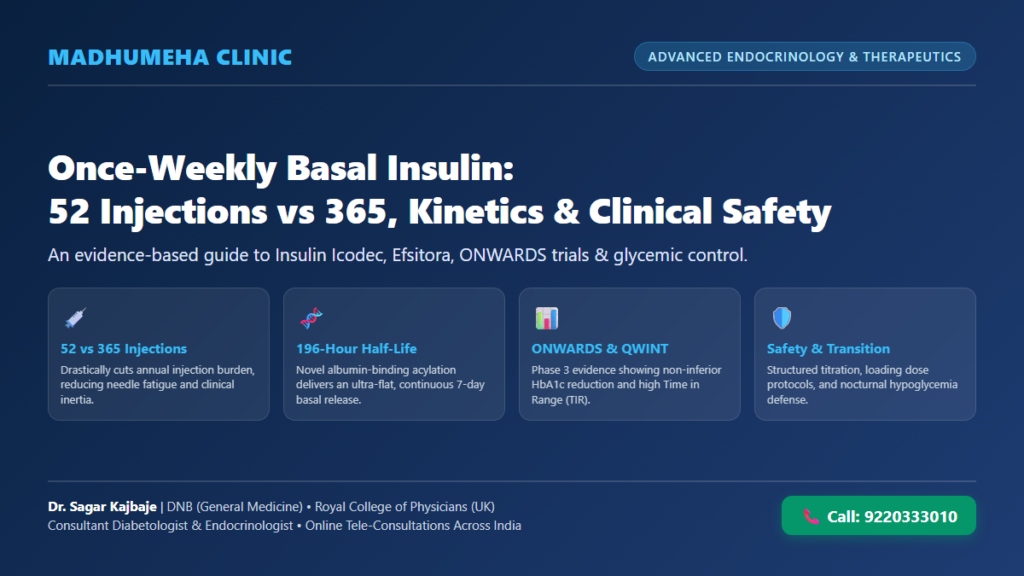
Icodec Insulin & Weekly Basal Insulin Guide | Madhumeha
Living with diabetes requires daily commitment. Many patients struggle to maintain evening injection routines while balancing demanding work schedules. Needles cause fatigue. After fifteen years treating diabetes in our Thane clinic, I see how psychological resistance delays necessary insulin initiation for several years. Hesitation stalls control. When evaluating new therapies, icodec insulin represents a welcome clinical option that delivers steady basal coverage through one weekly subcutaneous dose. Clear facts build confidence. Medical guidance begins with dispelling common myths about starting insulin therapy before initiating modern injectable regimens. Knowledge dispels fear. Understanding how this weekly molecule behaves allows people to make informed decisions regarding their metabolic health.
The Science Behind Once Weekly Basal Insulin Therapy
Molecular Engineering and Human Albumin Binding
Albumin binds circulating molecules. Bioengineers modified the natural insulin molecule through targeted structural adjustments to create icodec insulin as an effective once weekly basal insulin for clinical practice. Three amino acids change. Scientists introduced substitutions at positions A14E, B16H, and B25H to reduce enzymatic cleavage while slowing clearance through the hepatic insulin receptor. Stability increases markedly. Researchers also attached a C20 icosanedioic acid fatty diacid sidechain to lysine at position B29 using a hydrophilic linker. Binding remains strong. Over ninety-nine percent of circulating drug reversibly attaches to human serum albumin, forming an inactive circulating reservoir in plasma that shields the molecule from rapid enzymatic degradation. Enzymes cannot degrade. As free icodec insulin activates receptors, albumin continuously releases active molecules to maintain a prolonged half-life of 196 hours. Seven days pass smoothly. In contrast, Insulin Efsitora alfa achieves weekly basal duration by fusing a single-chain insulin variant directly to an IgG2 Fc domain.
Prolonged Pharmacokinetics and Flat Receptor Action
Steady release protects cells. Traditional daily basal analogs produce minor peak-and-trough variations across twenty-four hours in sensitive diabetic patients. Variations cause anxiety. With icodec insulin, prolonged albumin binding ensures receptor activation continues at an even pace without sharp swings in plasma concentration. Tissues receive baseline coverage. This flat profile suppresses overnight hepatic gluconeogenesis without driving fasting blood sugars into dangerous nocturnal lows. Morning readings stay predictable. Control endures. Glucose stabilizes.
How Icodec Insulin Overcomes Needle Fatigue and Clinical Inertia
Cutting 365 Daily Injections to 52 Doses Per Year
Daily injection regimens demand discipline that frequently leads to severe physical and psychological fatigue. Injections demand vigilance. Taking daily basal insulin requires 365 subcutaneous shots each calendar year, causing noticeable abdominal lipohypertrophy and significant mental reluctance over time. Travel disrupts timing. Busy professionals often skip daily doses because administering injections during dinner parties or office meetings creates embarrassment. Weekly dosing removes stigma. By replacing daily punctures with icodec insulin, individuals reduce their yearly injection count by eighty-six percent, transitioning from 365 painful daily subcutaneous injections to just fifty-two planned weekly doses. Fewer shots provide relief. While certain individuals manage their daily routines with modern insulin delivery devices like smart pens and pumps, a weekly injection simplifies therapy. Simplicity promotes compliance.
Improving Treatment Adherence and Real-World Glycemic Control
When patients miss daily insulin doses, their blood glucose levels rebound upward and remain erratic. Adherence drives clinical success. Weekly schedules with icodec insulin allow patients to choose one consistent administration day, such as Sunday morning after breakfast. Routines become automatic. Family members can easily assist in tracking fifty-two doses per year rather than reminding someone every night. Better adherence lowers complications. Vessels heal. Organs thrive. Maintaining consistent basal levels limits harmful glucose spikes that damage delicate retinal capillaries and kidney glomeruli.
Awiqli Insulin in Global Diabetes Management
Regulatory Approvals and International Availability
Global approvals expand. International health authorities evaluated clinical evidence for this formulation before granting formal marketing clearance across multiple continents. Brand names enter clinics. Pharmaceutical manufacturer Novo Nordisk supplies this molecule under the commercial trade name Awiqli in the European Union, Canada, Japan, and Australia. American reviews continue actively. The United States Food and Drug Administration requested supplementary manufacturing metrics and additional clinical data regarding hypoglycemia tracking. India prepares for introduction. In the domestic healthcare sector, awiqli insulin advances through clinical assessment pathways supervised by the Central Drugs Standard Control Organization. Availability will expand soon.
Clinical Indications for Type 2 Diabetes Mellitus
Endocrinologists prescribe weekly basal formulations specifically for adult patients diagnosed with type 2 diabetes mellitus. Guidelines define eligibility. The treatment serves individuals starting insulin for the first time as well as those replacing daily basal shots. Avoid type 1. Regulatory agencies do not recommend weekly basal therapy for type 1 diabetes because of unpredictable fluctuations in daily carbohydrate intake. Patient safety guides decisions. Without functioning beta cells, long-acting weekly depot insulins present an unacceptable risk of prolonged low blood sugars.
What the ONWARDS Clinical Trials Reveal About Weekly Insulin
Glycemic Efficacy and Time in Range Superiority
Clinical trials showed superiority. The ONWARDS clinical trial program evaluated weekly insulin across six phase 3 trials involving more than four thousand diabetic participants worldwide. ONWARDS 1 compared glargine. Insulin-naive patients taking icodec insulin achieved an average HbA1c drop of 1.55 percent compared to 1.35 percent with once-daily insulin glargine U100. Continuous monitors tracked stability. Patients receiving weekly therapy achieved 72 percent Time in Range, whereas daily glargine recipients reached only 67 percent. Numbers prove control. Endocrinologists monitor these gains through continuous glucose monitoring Time in Range metrics during quarterly clinical reviews. Target zones protect organs. Nerves recover. Peace returns.
Comparing Icodec and Efsitora Alfa in Large-Scale Studies
Researchers also evaluated weekly insulin efsitora alfa in the QWINT clinical trial program against daily insulin degludec. Efsitora demonstrated equal power. QWINT findings confirmed that once-weekly efsitora matched daily degludec in reducing glycated hemoglobin with similar safety outcomes. Evidence continues growing. Both molecules confirm that seven-day dosing matches or exceeds the glycemic benefits provided by daily basal injection therapies. Individualize every target level. Sound medical practice relies on understanding clinical HbA1c targets aligned with individual age and cardiovascular risk status.
Transitioning from Daily Shots to a Weekly Insulin Injection
Structured Loading Doses and Steady-State Kinetics
Transitioning requires precision. Because of its extended half-life, a weekly insulin injection requires several weeks to reach steady plasma concentrations without special initiation. Delays harm control. To bridge this pharmacokinetic gap, clinicians prescribe a structured one-time loading dose on Day 1 of starting icodec insulin therapy. Dosage calculations follow formulas. Patients switching from daily basal analogs receive 700 percent of their daily basal dose plus an additional 50 percent on Day 1. Steady-state arrives by Week 2. For insulin-naive individuals, the starting dose equals 700 percent of the recommended daily basal dose without extra loading units. Maintenance proceeds once weekly.
Weekly Titration Algorithms Based on Fasting Glucose
Adjusting weekly doses follows a systematic algorithm based on fasting self-monitored blood glucose readings taken before breakfast. Calculate three-day fasting averages. If the three-day average exceeds 130 mg/dL, the physician increases the weekly dose by twenty units. Normal readings require stability. When fasting numbers average between 80 and 130 mg/dL, the weekly dose remains at the current level. Low readings prompt reductions. Any average dropping below 80 mg/dL leads to a prompt twenty-unit reduction in weekly insulin dosing.
Hypoglycemia Vigilance and Patient Safety with Insulin Icodec
Differentiating Level 1 and Level 2 Hypoglycemia Events
Safety demands scrutiny. In large clinical trials, overall hypoglycemia frequency observed with insulin icodec remained low and clinically manageable. Endocrinologists separate low readings. Level 1 hypoglycemia describes blood glucose between 54 and 69 mg/dL, prompting mild autonomic symptoms like sweating or shakiness. Level 2 deepens. Level 2 hypoglycemia indicates severe drops below 54 mg/dL that require immediate fast-acting carbohydrate rescue intervention. Severe episodes remained rare. Trial participants experienced primarily mild Level 1 events without unconsciousness, proving that steady albumin release buffers sudden glucose falls.
Nocturnal Safety Protocols and Patient Education
Nighttime safety needs attention. Because the formulation circulates for seven full days, patients must understand appropriate rescue protocols for unexpected low glucose episodes. Preparation prevents complications. We instruct patients on recognizing and preventing silent nocturnal hypoglycemia before they administer their first injection at home. Keep glucose by bedtime. If blood sugar drops below 70 mg/dL, consume fifteen grams of fast-acting glucose tablets and retest fifteen minutes later. Continuous monitors add protection. Modern glucose sensors alert sleeping patients if their overnight readings trend downward toward hypoglycemic thresholds.
Authentic Clinical Vignettes from Madhumeha Clinic
Case Vignette: Mr Suresh Patil (name changed) from Thane
Real cases illustrate. Mr Suresh Patil (name changed), a 61-year-old retired railway engineer from Thane, struggled with longstanding type 2 diabetes. Multiple oral drugs failed. He took metformin, sulfonylureas, and daily glargine U100, yet his HbA1c climbed to 8.9 percent and fasting glucose hovered around 195 mg/dL. Needle fatigue worsened. Frequent travel between Thane and Pune caused missed evening doses, while social stigma prevented him from injecting in public places. Dr Sagar Kajbaje intervened. After assessing his clinical profile, Dr Sagar Kajbaje transitioned him to once weekly basal insulin using insulin icodec (Awiqli) alongside an initial loading dose. Injection burden dropped drastically. Mr Suresh Patil reduced his annual shots from 365 to 52, reaching 100 percent adherence over the next sixteen weeks. Results followed quickly. His Time in Range expanded from 42 to 76 percent, and his HbA1c dropped smoothly to 7.1 percent without nocturnal hypoglycemia.
Case Vignette: Mrs Shobha Joshi (name changed) from Kalyan
Needle fears delay therapy. Mrs Shobha Joshi (name changed), a 54-year-old high school principal from Kalyan, lived with uncontrolled type 2 diabetes for years. Her physician advised insulin. Paralyzed by needle phobia and psychological resistance, she postponed initiation for three years while her HbA1c surged to 9.4 percent. Chronic exhaustion persisted. Dr Sagar Kajbaje discussed her emotional barriers and introduced once weekly basal insulin therapy administered every Sunday morning. Acceptance shifted immediately. Knowing she faced only one small injection each week eliminated her daily dread and restored her confidence in treatment. Sugar levels stabilized. Under continuous glucose monitoring surveillance, her fasting glucose dropped to 116 mg/dL and her vitality returned without daily stress.
Clinical Comparison Matrix for Modern Basal Insulins
Pharmacology and Dosing Profiles of Leading Formulations
Basal formulations differ substantially. The comparative table below outlines the structural engineering, elimination half-lives, injection schedules, and clinical efficacy of leading basal insulins.
| Insulin Molecule & Formulation | Molecular Engineering & Terminal Half-Life | Dosing Frequency & Annual Injection Burden | Key Clinical Trial & Glycemic Efficacy |
|---|---|---|---|
| Insulin Icodec (Awiqli) | A14E, B16H, B25H substitutions with C20 fatty diacid chain; 196-hour half-life via albumin binding | Once weekly subcutaneous injection; 52 injections per year | ONWARDS 1 trial showed -1.55% HbA1c reduction and 72% Time in Range versus daily glargine |
| Insulin Efsitora Alfa | Single-chain insulin variant fused to human IgG2 Fc domain; ~17 days terminal half-life | Once weekly subcutaneous injection; 52 injections per year | QWINT phase 3 trials confirmed non-inferior HbA1c reduction and safety matching daily degludec |
| Insulin Glargine U300 (Toujeo) | Precipitates into subcutaneous microprecipitates; ~19 hours terminal half-life | Once daily subcutaneous injection; 365 injections per year | EDITION trial series demonstrated steady 24-hour basal control with reduced nocturnal hypoglycemia |
| Insulin Degludec U100 (Tresiba) | Forms soluble multi-hexamer chains in subcutaneous tissue; ~25 hours terminal half-life | Once daily subcutaneous injection; 365 injections per year | BEGIN and DEVOTE trials confirmed flat peakless profile with ultra-low glycemic variability |
Frequently Asked Questions About Once-Weekly Basal Insulin
1. How does once-weekly basal insulin work inside the body?
Molecular design enables longevity. Once-weekly basal insulin relies on amino acid substitutions and a fatty acid sidechain that binds reversibly to human serum albumin. Albumin forms a depot. Over ninety-nine percent circulates as an inactive reservoir, slowly releasing active molecules over seven days to provide steady glycemic control.
2. Is weekly insulin (icodec or Awiqli) available in India?
Domestic approvals advance. Weekly insulin formulations, including Awiqli, are currently undergoing clinical trial reviews with drug regulators in India. Several countries approved marketing. While the European Union, Canada, Japan, and Australia approved usage, commercial pharmacy availability in India awaits final regulatory clearance.
3. How do you switch from daily basal insulin to once-weekly insulin?
Switching follows formulas. Transitioning from daily basal insulin requires a physician-guided protocol that incorporates an initial loading dose on treatment Day 1. Loading prevents glycemic lag. Patients switching from daily analogs take 700 percent of their daily basal dose plus an extra 50 percent on Day 1. Regular maintenance follows weekly.
4. What do the ONWARDS clinical trials show about icodec insulin efficacy?
Clinical trials confirm efficacy. The ONWARDS phase 3 trials proved that icodec insulin provides superior or equivalent blood sugar reduction compared to daily basal insulins. HbA1c reductions impressed. In ONWARDS 1, weekly icodec achieved a 1.55 percent HbA1c reduction compared to 1.35 percent with daily glargine U100. Time in Range expanded.
5. What is the risk of hypoglycemia with once-weekly insulin injections?
Hypoglycemia risks remain low across large clinical trials. The flat pharmacokinetic profile of weekly injections minimizes sharp glucose troughs, resulting in few severe Level 2 or Level 3 events. Mild Level 1 occurs. Mild low readings respond rapidly to standard oral carbohydrates without requiring emergency medical care or hospital admission.
Expert Diabetes Care at Madhumeha Clinic
Managing diabetes requires expertise. When daily injection schedules create fatigue, modern pharmaceutical advances offer welcome relief for long-term health. Dr Sagar Kajbaje guides. Bringing fifteen years of specialized experience in endocrine medicine, Dr Sagar Kajbaje provides individualized care for complex diabetes cases. Professional credentials reassure. His qualifications include a DNB in General Medicine and a Post Graduate Diploma in Diabetes and Endocrinology from Royal College of Physicians. Thane residents visit directly. In-person consultations take place at Madhumeha Clinic in Thane West with diagnostics on site. Distance is no obstacle. For patients across Maharashtra and India, our center offers convenient online diabetes tele-consultation appointments from home. Reach our clinic today. Schedule an appointment directly: Call: 9220333010 or WhatsApp: 9220333010. Find our clinic easily. You can also view directions to Madhumeha Clinic on Google Maps.
[…] Related Clinical Guide: Modern weekly insulins significantly improve Time in Range metrics. Explore the complete clinical trials analysis in our once-weekly icodec basal insulin guide. […]