
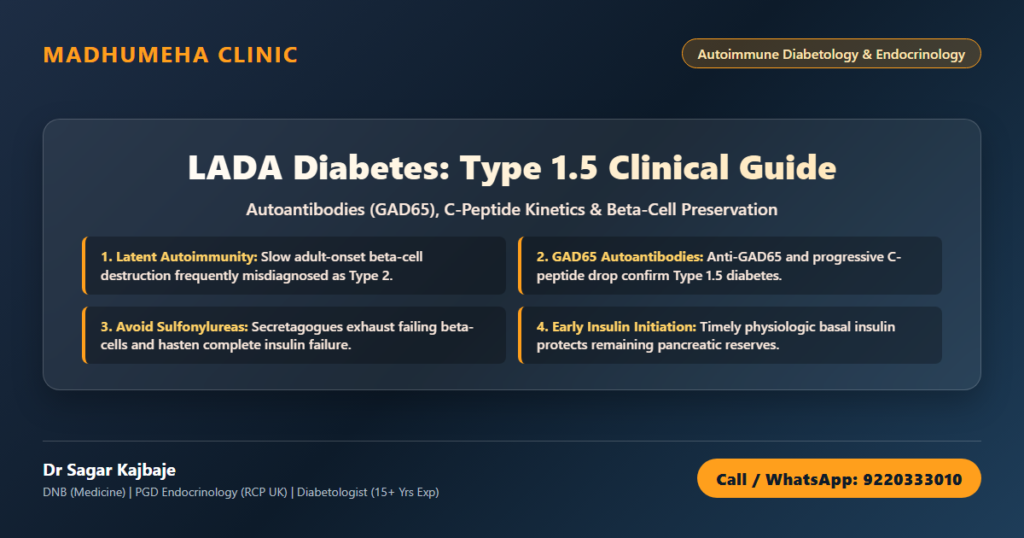
LADA Diabetes: Type 1.5 Symptoms, Diagnosis & Care
Every month at Madhumeha Clinic in Panchpakhadi, Thane West, I evaluate patients with adult-onset diabetes. Many do not fit the standard mold. They are lean, active, and diligent with their diet. Still, their blood sugar spirals out of control despite taking multiple oral tablets. These individuals do not suffer from traditional insulin resistance. Instead, they face an unmasked autoimmune assault known as lada diabetes.
Misdiagnosis happens every day. Because onset occurs during adulthood, busy clinics default to diagnosing Type 2 diabetes. Standard oral drugs follow. Sulfonylureas are added. Blood sugars improve briefly, then climb dramatically. The patient loses weight, battles exhaustion, and wonders what went wrong. Understanding the physiology of latent autoimmune diabetes in adults reveals why conventional treatments fail. Timely intervention safeguards long-term health.
## What is LADA Diabetes and How Does It Develop?
To answer what is lada diabetes, we must look directly at the pancreatic islet architecture. In clinical practice, Latent Autoimmune Diabetes in Adults represents a slow-burning form of autoimmune diabetes. Medical professionals frequently describe this condition as type 1.5 diabetes. It shares clinical features with both classic Type 1 and Type 2 diabetes.
Unlike classic Type 1 diabetes, which strikes children and young adults with sudden ketoacidosis, this adult condition progresses quietly. Autoreactive CD4+ and CD8+ T-lymphocytes migrate into the pancreatic islets. These immune cells launch targeted attacks against insulin-producing beta-cells. The process takes years. Early on, surviving beta-cells manage to produce enough insulin to prevent acute diabetic ketoacidosis. This residual capacity creates the illusion of typical adult diabetes.
The Immunology of Diabetes Society defines three strict diagnostic benchmarks for this condition:
– Adult age of disease onset, usually older than thirty or thirty-five years.
– Presence of circulating pancreatic islet autoantibodies in blood serum.
– Absence of an immediate requirement for insulin therapy for at least six months following diagnosis.
Autoantibodies act as biological fingerprints. The most common marker is Glutamic Acid Decarboxylase 65 autoantibody (anti-GAD65). Other circulating markers include Islet Antigen-2 autoantibodies (IA-2A) and Zinc Transporter 8 autoantibodies (ZnT8). When these autoantibodies circulate in an adult, progressive beta-cell destruction is already underway. Insulin production will inevitably drop.
## Recognizing Type 1.5 Diabetes Symptoms Early
Identifying type 1.5 diabetes symptoms requires looking beyond standard metabolic complaints. Classic symptoms like increased thirst, frequent urination, and blurred vision appear in all forms of hyperglycemia. However, subtle physiological markers distinguish autoimmune cases from metabolic lifestyle diabetes.
Adults with autoimmune diabetes rarely exhibit the classic markers of insulin resistance. You will not find significant central obesity, severe dyslipidemia, or acanthosis nigricans on their necks. Instead, these patients experience unexpected weight loss despite maintaining their usual food intake. They describe a profound, draining physical exhaustion that sleep does not relieve.
Beta-cells fail quietly. As circulating insulin levels decline, muscle tissue and adipose cells starve for cellular energy. Blood glucose rises while body tissues break down fat stores for baseline fuel. An adult patient with normal body mass index may present with refractory hyperglycemia. Physicians must immediately screen for underlying autoimmunity.
Patients frequently notice that physical activity no longer lowers blood sugar predictably. What previously caused a drop in glucose readings now causes swings. Recognizing these patterns allows for early autoantibody testing before severe metabolic decompensation occurs.
## C-Peptide Kinetics: The Decisive Diagnostic Test
Relying solely on routine fasting blood glucose or understanding your HbA1c test results will never differentiate autoimmune diabetes from lifestyle-driven disease. Both show elevated glycated hemoglobin. The decisive laboratory evaluation lies in measuring fasting and stimulated C-peptide alongside anti-GAD65 autoantibody titers.
C-peptide serves as a direct mirror of endogenous insulin secretion. For every molecule of insulin produced by the pancreas, an equimolar molecule of C-peptide enters the bloodstream. Comparing these values provides clarity:
– Classic Type 2 diabetes: High fasting C-peptide (frequently above 2.5 to 3.0 ng/mL) accompanied by elevated fasting insulin, reflecting severe peripheral insulin resistance.
– Acute Type 1 diabetes: Undetectable or near-zero C-peptide (below 0.2 ng/mL), signifying complete autoimmune beta-cell loss.
– LADA / Type 1.5 diabetes: Low-normal or borderline C-peptide at initial presentation (often between 0.6 and 1.5 ng/mL), followed by a persistent downward trajectory over two to five years.
Tracking C-peptide over time maps the rate of beta-cell loss. When I evaluate patients from Thane or Kalyan, a declining C-peptide level confirms that oral medications cannot sustain metabolic control. Testing confirms the diagnosis. Objective numbers guide clinical decisions.
## Why Sulfonylureas Cause Harm in Latent Autoimmune Diabetes in Adults
One of the most dangerous and common diabetes medication mistakes in adult diabetes management involves prescribing sulfonylureas to someone with unrecognized autoimmune beta-cell destruction.
Drugs such as glimepiride, glipizide, and gliclazide function as insulin secretagogues. They bind directly to the SUR1 regulatory subunit of ATP-sensitive potassium channels on beta-cell membranes. This binding forces channel closure, triggers cell depolarization, stimulates calcium influx, and commands the cell to dump its remaining stored insulin.
In an autoimmune pancreas, this chemical whip produces catastrophic consequences:
– Accelerated beta-cell apoptosis: Forcing damaged cells to hyper-secrete insulin heightens endoplasmic reticulum stress and triggers accelerated cell death.
– Heightened immune presentation: Hyperactive beta-cells express higher levels of surface autoantigens, drawing autoreactive T-lymphocytes directly to the islets.
– Rapid secondary oral agent failure: Patients experience an artificial honeymoon for three to six months, followed by complete beta-cell exhaustion and runaway glucose toxicity.
Secretagogues exhaust reserves. When treating latent autoimmune diabetes in adults, physicians must discontinue sulfonylureas immediately upon detecting autoantibody positivity. Whipping a failing gland destroys the remaining biological infrastructure.
## Clinical Protocol Matrix: Diagnostic & Therapeutic Pathways
| Clinical Diagnostic Domain | Pathophysiological Mechanism & Patient Risk | Evidence-Based Management Protocol | Target Clinical Outcome |
| :— | :— | :— | :— |
| Autoantibody Screening (Anti-GAD65) | Autoreactive T-cell destruction of beta-cells; high risk of rapid misdiagnosis as Type 2 diabetes | Order quantitative anti-GAD65, IA-2A, and ZnT8 antibody assays in lean adults with escalating blood sugars | Early, unequivocal confirmation of pancreatic autoimmune disease within weeks |
| C-Peptide Trajectory Monitoring | Gradual loss of functional beta-cell mass leading to absolute endogenous insulin deficiency | Measure baseline fasting C-peptide with concurrent glucose; repeat every six to twelve months | Accurate tracking of secretory capacity and timely escalation of therapy |
| Pharmacological De-escalation | Sulfonylurea-induced SUR1 stimulation accelerates beta-cell apoptosis via endoplasmic reticulum stress | Immediately discontinue all sulfonylureas and meglitinide secretagogues upon positive autoantibody confirmation | Preservation of residual islet beta-cell reserve and prevention of premature secretory failure |
| Physiologic Insulin Replacement | Unchecked glucotoxicity accelerates immune destruction; endogenous beta-cell rest slows antibody attack | Introduce low-dose once-daily basal insulin analogs to rest remaining pancreatic islets | Stable glycemic control, HbA1c below 7.0%, and long-term prevention of diabetic ketoacidosis |
## Clinical Vignette: Misdiagnosed LADA in Panchpakhadi, Thane West
Mr Rajesh Kulkarni (name changed), a 42-year-old software consultant residing in Panchpakhadi, Thane West, walked into my consultation room looking exhausted and anxious. Two years prior, a routine corporate health checkup revealed a fasting blood sugar of 184 mg/dL. His body mass index stood at 22.4 kg/m². Despite his lean build and active lifestyle, he was started on metformin 500 mg twice daily for presumed Type 2 diabetes.
Over the subsequent eighteen months, his numbers deteriorated. His previous physician escalated therapy, eventually prescribing high-dose metformin combined with glimepiride 4 mg daily. Rather than improving, Mr Rajesh Kulkarni (name changed) experienced progressive weight loss of 6 kg, persistent muscle weakness, and debilitating post-meal fatigue. His latest HbA1c had skyrocketed to 10.8%.
Recognizing the classic pattern of secondary oral failure in a lean adult, I immediately ordered thorough diagnostic testing. His anti-GAD65 antibody titer came back markedly positive at greater than 250 IU/mL. His fasting C-peptide was severely depleted at 0.42 ng/mL with a concurrent glucose of 218 mg/dL.
His diagnosis was clear: advanced lada diabetes mismanaged with secretagogues. I promptly stopped his glimepiride to remove chemical stress from his remaining islets. We initiated a physiologic basal-bolus insulin regimen using modern insulin analogs. Within twelve weeks, his blood sugars stabilized. His HbA1c dropped to 6.8% without a single episode of hypoglycemia, his lost muscle mass returned, and his remaining pancreatic cells were protected from further exhaustion.
## Clinical Vignette: Autoimmune Clustering in Kalyan
Mrs Sunita Deshpande (name changed), a 47-year-old school principal from Kalyan, presented to our clinic with volatile glucose readings. She had managed Hashimoto’s thyroiditis for nine years on stable thyroxine replacement. Six months before our visit, she developed polyuria and mild weight loss. Her local doctor diagnosed Type 2 diabetes and started her on glipizide 10 mg daily.
Her response was turbulent. She suffered from erratic daytime glucose spikes alternating with symptomatic late-afternoon hypoglycemic drops. Continuous glucose monitoring revealed a Time in Range of only 44%, with glucose levels swinging between 58 mg/dL and 290 mg/dL.
Autoimmune diseases rarely travel alone. Mrs Sunita Deshpande (name changed) carried an established autoimmune thyroid condition, raising immediate suspicion for polyglandular autoimmune involvement. Her diagnostic panel confirmed elevated anti-GAD65 titers and a borderline fasting C-peptide of 0.9 ng/mL.
She was living with latent autoimmune diabetes in adults. We immediately eliminated the sulfonylurea. To address her remaining secretory capacity, we started low-dose once-daily basal degludec insulin combined with a GLP-1 receptor agonist, similar to the strategies discussed when choosing between SGLT2 inhibitors and GLP-1 medications. This combination preserved her residual islet function while buffering glycemic variability. Within eight weeks, her Time in Range climbed to 82%, her energy returned, and her daily glucose profile smoothed out completely.
## Modern Evidence-Based Type 1.5 Diabetes Treatment
Designing a successful type 1.5 diabetes treatment plan requires aligning pharmacological tools with the underlying pathology. Because beta-cell loss is progressive, the treatment strategy must evolve alongside the patient’s secretory reserve.
Insulin preserves life. The traditional fear that starting insulin makes a patient dependent on injections has no biological foundation in autoimmune diabetes. In fact, initiating low-dose basal insulin early in the disease course provides profound therapeutic benefits:
– Islet rest: Exogenous basal insulin reduces the secretory burden on surviving beta-cells, lowering cellular stress.
– Reduced autoantigen exposure: Resting beta-cells express fewer surface antigens, dampening T-cell-mediated immune attack.
– Glucotoxicity resolution: Clearing persistent glucose toxicity protects remaining islets from non-immune metabolic damage.
For patients with early-stage disease and preserved C-peptide levels, metformin remains a helpful adjunct to address background hepatic glucose production. DPP-4 inhibitors and GLP-1 receptor agonists may offer anti-inflammatory and beta-cell protective effects during early stages, provided C-peptide levels remain adequate. However, SGLT2 inhibitors must be prescribed with caution. In insulin-deficient states, SGLT2 inhibitors carry an increased risk of euglycemic diabetic ketoacidosis.
As autoimmune destruction advances, patients eventually make a planned transition from once-daily basal insulin to full physiological basal-bolus or automated insulin delivery, similar to managing autoimmune Type 1 diabetes with insulin. Early diagnosis protects. Regular monitoring ensures this transition happens proactively before emergency hospital admission becomes necessary.
## Frequently Asked Questions
### What is LADA diabetes, and how is it different from classic Type 2 diabetes?
LADA diabetes is an autoimmune condition where the body’s immune system slowly destroys pancreatic beta-cells in adults. In classic Type 2 diabetes, the pancreas produces substantial insulin, but peripheral tissues resist its action due to metabolic factors. In contrast, this condition is driven by circulating autoantibodies like anti-GAD65. It leads to progressive absolute insulin deficiency rather than pure metabolic resistance.
### What are the primary symptoms and diagnostic tests for Type 1.5 diabetes?
Primary symptoms include persistent fatigue, unexplained weight loss, polyuria, polydipsia, and poor glycemic response to standard oral medications in lean adults. Diagnostic confirmation requires testing for circulating autoantibodies (anti-GAD65, IA-2A, and ZnT8) combined with fasting and stimulated C-peptide measurements to evaluate pancreatic reserve.
### Why should sulfonylureas be avoided in latent autoimmune diabetes in adults?
Sulfonylureas force failing pancreatic beta-cells to oversecrete stored insulin by binding to SUR1 receptors. In autoimmune diabetes, this forced overactivity causes endoplasmic reticulum stress, accelerates beta-cell death, and leads to rapid secondary failure of blood sugar control.
### Does LADA / Type 1.5 diabetes always eventually require insulin treatment?
Yes. Because immune-mediated destruction of pancreatic beta-cells continues over time, endogenous insulin production inevitably declines below physiological needs. Timely initiation of low-dose basal insulin early in the disease preserves remaining beta-cells, while full insulin replacement becomes necessary as the condition matures.
## Take Control of Your Diabetes Care
A diabetes diagnosis should never be based on guesswork or assumptions. If you are struggling with unexplained weight loss, poor response to oral diabetes tablets, or severe energy fluctuations despite a lean lifestyle, you may be living with undiagnosed autoimmune diabetes.
At Madhumeha Clinic, Dr Sagar Kajbaje brings over 15 years of specialized clinical experience. Holding a DNB in General Medicine and a Post Graduate Diploma in Diabetes and Endocrinology from the Royal College of Physicians (UK), he focuses on accurate diagnosis, advanced antibody testing, and metabolic therapies.
Patients across Thane, Kalyan, Mumbai, and greater Maharashtra can access in-person evaluations or convenient online diabetes tele-consultation services from home.
Book your consultation today:
– Phone: Call: 9220333010 or WhatsApp: 9220333010
– Location: Visit Madhumeha Clinic on Google Maps for directions to our Panchpakhadi, Thane West clinic.