
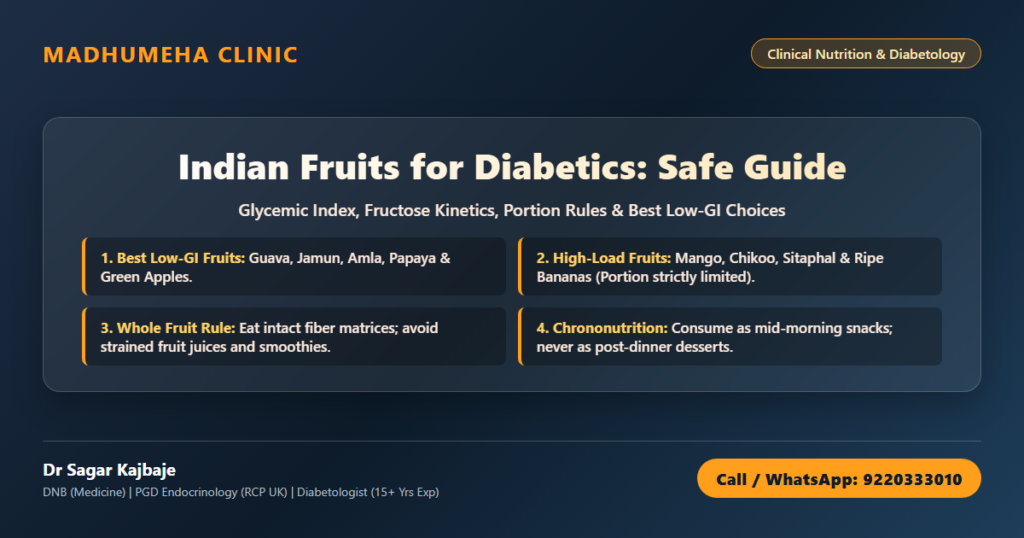
Fruits for Sugar Patients: Best Low GI Indian Guide
Patients frequently enter our consultation room with genuine anxiety whenever conversation turns toward fresh seasonal fruit. Many people believe that every fruit transforms into dangerous poison the moment a patient develops diabetes. When examining safe fruits for sugar patients, clinical facts reveal a much more encouraging reality. Fruits contain fiber. Whole botanical fruits arrive wrapped in complex plant cell walls filled with soluble pectin, polyphenols, potassium, and protective organic acids. These structural components delay gastric breakdown. Pectin swells. Fiber shields tissue. Digestion slows. In addition, maintaining steady brain glucose metabolism protects cognitive function, as detailed in our guide on टाइप 3 डायबिटीज और अल्जाइमर का संबंध (Type 3 Diabetes Symptoms).
At Madhumeha Clinic in Panchpakhadi, Thane West, we guide patients away from unnecessary dietary fear toward evidence-based metabolic management. Total carbohydrate deprivation often backfires. Cravings intensify. Energy drops. Patients who eliminate fresh produce entirely face micronutrient deficiencies, sluggish digestion, and intense late-night sugar cravings. Sustainable glycemic stability requires portion discipline, intelligent food pairing, and biological knowledge. Before modifying your daily intake, begin by understanding your HbA1c test results to evaluate your baseline glycemic control accurately.
Mr Suresh Patil (name changed) from Naupada, Thane West, illustrates how misconceptions harm metabolic health. Age 54, he worked as a high school mathematics teacher with Type 2 Diabetes. Following his initial diagnosis, well-meaning neighbors terrified him by claiming that all fruits turn directly into poison in diabetic blood. He eliminated every fruit completely for two years. As a result, he developed chronic constipation, micronutrient fatigue, and unbearable late-night sugar cravings that drove him to binge on processed tea biscuits. When Dr Sagar Kajbaje evaluated his diet, he diagnosed fiber deficiency and re-introduced whole low-GI Indian fruits: whole green guava with seeds and fresh jamun during summer. Dr Kajbaje explained the actions of soluble pectin and jamboline alkaloids. Within eight weeks, Mr Patil’s bowel regularity returned, his cravings stopped, and his HbA1c dropped from 8.4% to 7.1%.
## The Myth of Sugar Free Fruits for Diabetics
### Whole Plant Cellular Matrix Versus Refined Sugars
Widespread internet searches for sugar free fruits for diabetics reflect understandable confusion. People hope to find sweet seasonal fruit varieties that contain zero sugar molecules. But botanists know that true sugar free fruits for diabetics simply do not exist in nature. Every edible fruit produces carbohydrates. Fructose, glucose, and sucrose form the normal energy currency of ripening plants.
Context determines physiological impact. Cellular architecture governs digestion. Pure table sugar and commercial high-fructose corn syrup arrive as naked carbohydrates that rush into the bloodstream unchecked. In contrast, whole fruits preserve an intact cellular matrix. Cell walls resist chewing. Plant fibers entrap simple sugars within microscopic fluid compartments, forcing the intestine to dismantle the tissue slowly. This delayed diffusion prevents sudden glycemic spikes, allowing endogenous beta-cells to coordinate measured insulin secretion rather than confronting an overwhelming flood of rapidly absorbable monosaccharides. Beta-cells rest. Hormones balance. Whole fruits digest steadily.
### Why Juicing Destroys Nature’s Protective Defense
Liquid fruit preparations eliminate these protective physical barriers entirely. Because hepatocytes receive an unrestrained surge of simple sugars without intestinal pacing, the liver channels surplus fructose into de novo lipogenesis, provoking triglyceride elevation and accelerating steatotic infiltration. Lipids accumulate. Vessels suffer. Juicing strips pectin. When blades slice through orange pulp, pomegranate arils, or fresh sweet lime, they pulverize the insoluble cellulose structure. The beverage becomes free liquid sugar.
Liquid fructose empties from the stomach within minutes. It enters the small intestine rapidly, triggering an instantaneous flood of monosaccharides directly into the portal vein. Even fresh unsweetened juice provokes steep post-prandial glycemic excursions. Drinking three whole oranges as juice takes thirty seconds, yet eating three whole oranges requires ten minutes of conscious chewing. Whole cellular integrity matters. Always eat whole fresh fruit with its skin and pulp intact, and discard the electric juicer.
## Low GI Fruits for Diabetics: Selecting the Best Options
### Therapeutic Indian Fruits: Guava, Jamun, and Amla
Selecting low gi fruits for diabetics provides sustained cellular nourishment without overtaxing pancreatic beta-cells. The Glycemic Index quantifies how rapidly fifty grams of available carbohydrate from a test food raises blood glucose compared to pure glucose. Foods scoring below 55 fall into the low category. Indian farms produce three exceptional therapeutic fruits that every diabetic should know.
First stands the humble guava. Guava features an exceptionally low Glycemic Index between 12 and 20. Its rough skin and hard internal seeds pack dense insoluble cellulose and soluble pectin. In the digestive tract, this pectin swells into a viscous gel. The gel layer lines the intestinal mucosa, slowing glucose diffusion and blunting post-meal spikes, making guava one of the safest fruits for sugar patients.
Second, the dark purple jamun (black plum) offers remarkable biochemical utility. Jamun carries a low Glycemic Index near 25. The fruit contains unique bioactive phytochemicals called jamboline and jambosine. These glycoside compounds actively inhibit intestinal alpha-amylase and alpha-glucosidase enzymes, suppressing the rapid conversion of dietary starches into simple blood glucose.
Third, fresh amla (Indian gooseberry) provides concentrated ascorbic acid alongside emblicanin polyphenols. These strong antioxidants neutralize circulating free radicals, protecting surviving pancreatic beta-cells against chronic glucotoxicity. Combining low gi fruits for diabetics with a smart food sequencing strategy to control blood sugar stabilizes post-prandial curves throughout the afternoon.
### Glycemic Index Versus Glycemic Load: The Watermelon Paradox
Evaluating fruit safety requires distinguishing between Glycemic Index and Glycemic Load. Glycemic Index measures sugar release speed, whereas Glycemic Load factors in the actual carbohydrate quantity within an average serving. Mathematically, Glycemic Load equals the Glycemic Index multiplied by available carbohydrates in grams, divided by one hundred.
Watermelon highlights this paradox clearly. Watermelon registers a high Glycemic Index of 72. At first glance, diabetics might avoid it completely. Yet water constitutes 92 percent of its red flesh. A standard 120-gram serving contains barely 6 grams of carbohydrates, resulting in a tiny Glycemic Load of just 4.3. Moderation brings safety. A modest slice produces negligible glucose surges, especially when eaten after meals rich in dietary fibers that slow gastric emptying and blunt intestinal carbohydrate absorption. Portions govern spikes. Safety follows rules.
Conversely, high Glycemic Load fruits present genuine clinical danger. Custard apple (sitaphal), chikoo (sapodilla), and fully ripened bananas pack between 20 and 25 grams of concentrated sugars into small portions. Their dense pulp creates rapid portal floods that raise post-prandial blood readings for several hours.
## Can Diabetics Eat Mango? Clinical Truth and Slicing Strategies
### Hepatic Fructose Metabolism and Fat Accumulation
Patients across Maharashtra constantly ask one urgent question: can diabetics eat mango during the long-awaited summer season? The clinical answer demands nuance. Molecules dictate metabolic pathways. Context governs outcomes. Mango pulp contains significant sucrose and free fructose. Understanding the liver explains why uncontrolled mango indulgence causes metabolic damage.
Fructose bypasses glucose sensors. Liver enzymes activate. Pathways saturate. While glucose entry into cellular glycolysis requires regulation by the gatekeeper enzyme phosphofructokinase (PFK), hepatic fructose clearance proceeds without feedback inhibition. Unbound fructose enters hepatocyte glycolysis downstream as triose phosphates. The liver metabolizes this sugar uncontrollably because fructose bypasses the primary rate-limiting phosphofructokinase checkpoint, delivering an uninterrupted flood of triose phosphate intermediates directly into triglyceride synthesis pathways. Pathways saturate. Lipids accumulate.
When hepatocytes receive an excessive fructose flood while glycogen stores are full, they cannot store the surplus energy safely. Instead, the liver turns on de novo lipogenesis (DNL). Livers synthesize fats. This biochemical process packages excess carbons into dangerous triglycerides, raising very-low-density lipoproteins (VLDL), worsening metabolic dysfunction-associated steatotic liver disease (MASLD), and triggering stubborn peripheral insulin resistance.
### Safe Mango Protocols: Slicing, Pairing, and Savoring
So can diabetics eat mango without wrecking their glucose metrics? Yes, provided patients follow disciplined clinical parameters. Never eat whole large mangoes alone. Instead, restrict the portion to two thin slices (approximately 60 grams of edible pulp).
Pairing prevents damage. Consume those two slices alongside five raw soaked almonds or two walnut halves. Healthy fats and vegetable proteins from our clinical guide to dry fruits and nuts for diabetes physically slow stomach emptying, preventing rapid hepatic absorption.
Mrs Meena Kulkarni (name changed) from Kalyan, a 61-year-old homemaker with an 11-year history of Type 2 Diabetes, illustrated this exact physiological trap. Every summer, she experienced massive unexplained evening glucose spikes exceeding 270 mg/dL. Her continuous glucose sensor revealed that she was eating two large Alphonso mangoes every evening as post-dinner dessert while watching television. Dr Sagar Kajbaje analyzed her glycemic curves and explained hepatic fructose kinetics: post-dinner sedentary consumption floods the liver when glycogen stores are already full, driving de novo lipogenesis and overnight insulin resistance. Dr Kajbaje restructured her fruit intake: allowing two thin slices of fresh mango (around 60g) strictly at 11 AM as a mid-morning snack paired with five raw soaked almonds, while replacing late-night dessert with unsweetened homemade curd. Her nocturnal glucose stabilized below 120 mg/dL, and her post-meal excursions flattened dramatically.
## Good Fruits for Sugar Patients: Safe Choices and Metabolic Benefits
### Smart Serving Sizes and Macronutrient Buffers
Identifying good fruits for sugar patients requires evaluating both portion volume and digestive speed. Safe options include crisp green apples, raw guavas, Indian blackberries (jamun), firm papayas, and ruby pomegranate seeds. Clinically recognized good fruits for sugar patients combine moderate sweetness with high water content and abundant cellular fiber.
Portion control remains non-negotiable. Even healthy fruits produce excessive glycemic loads when eaten by the bowlful. A standard therapeutic serving equals approximately 100 to 120 grams of whole edible flesh. Desk workers who sit for hours must pay special attention to meal compositions. For actionable workplace strategies, review our glucose management guide for desk workers.
To help you choose wisely, we structured this four-column clinical protocol matrix:
### Clinical Protocol Matrix: Fruit Selection and Safety Profile
| Fruit Variety & Category | Glycemic Index & Biochemical Profile | Recommended Clinical Portion & Timing | Expected Metabolic Impact & Liver Safety |
| :— | :— | :— | :— |
| Low-GI High-Pectin Fruits (Guava, Jamun, Amla) | GI 12-25. Abundant soluble pectin, insoluble seed fibers, and alpha-glucosidase inhibitory glycosides. | 1 medium whole guava (100g) or 8-10 fresh jamun fruits at 11:00 AM. | Minimal glycemic excursion. Slow intestinal diffusion protects hepatocytes from sudden fructose saturation. |
| Moderate-GI Hydrating Fruits (Papaya, Pomegranate, Apple) | GI 38-55. Rich in papain, punicalagins, and quercetin; balanced fructose-to-fiber ratio. | 1 small cup diced papaya (100g) or half cup pomegranate arils at 4:30 PM. | Modest, manageable glucose rise. Potent cardiovascular polyphenols support arterial endothelial elasticity. |
| High Glycemic Load Fruits (Mango, Chikoo, Sitaphal) | GI 51-65, high GL (12-18). Dense sucrose and free fructose with low relative fiber. | Strictly maximum 2 thin slices (60g), paired with 5 raw almonds; never eat daily. | Rapid portal influx. Consuming excess quantities triggers hepatic de novo lipogenesis and raises VLDL triglycerides. |
| Processed Fruit Juices & Smoothies (Strictly Contraindicated) | High GI (68-80+), GL > 20. Pulverized cellular structures with zero mastication resistance. | 0 mL. Completely excluded from clinical diabetes management plans. | Severe post-prandial hyperglycemia. Accelerates fatty liver changes and amplifies nocturnal insulin resistance. |
Consistently choosing these recommended fruits for sugar patients maintains antioxidant defenses while keeping post-prandial curves completely safe.
## Chrononutrition: The Best Time to Eat Fruits for Diabetics
### Daytime Skeletal Muscle Contraction and Non-Insulin Glucose Disposal
Chronobiology reveals that the human body handles carbohydrates with varying efficiency depending on the hour of the day. The best time to eat fruits for diabetics falls squarely during active daylight hours. Specifically, 10:30 AM (between breakfast and lunch) or 4:30 PM (between lunch and dinner) represent prime windows.
Active movement burns circulating sugars. When you walk, climb stairs, or perform routine physical chores during midday, contracting skeletal muscles recruit glucose transporter type 4 (GLUT4) protein carriers to cell membranes. Muscle contractions transport sugar without requiring heavy insulin secretion. This non-insulin dependent glucose disposal pathway clears carbohydrate energy rapidly. Mid-morning fruit fuels active tissues directly.
### The Pitfalls of Late-Night Fruit Consumption
Conversely, evening fruit consumption invites severe metabolic disruption. Sedentary evenings invite trouble. Eating a bowl of fruit or sweet mango after 8:30 PM floods the bloodstream when your basal metabolic rate slows.
Your hepatic glycogen stores already sit full following your evening dinner. Without physical activity to pull glucose into peripheral skeletal muscles, the liver redirects the nocturnal fructose load straight into fatty acid synthesis. Sedentary nights invite metabolic dysfunction. Livers suffer. Vessels stiffen. Nighttime fruit intake fuels dawn phenomenon surges, leaving morning fasting readings frustratingly elevated. Establishing the best time to eat fruits for diabetics as a daytime habit shields both liver and cardiovascular systems.
Dr Sagar Kajbaje, DNB (General Medicine) and Post Graduate Diploma in Diabetes and Endocrinology from the Royal College of Physicians (UK), brings over 15 years of clinical experience to evidence-based metabolic care. Whether you visit our clinic in person or require a convenient online diabetes tele-consultation from anywhere across Maharashtra or India, our team provides individualized treatment plans. Reach out today: Call: 9220333010 or WhatsApp: 9220333010. You can also view directions to Madhumeha Clinic on Google Maps to plan your visit.
## Frequently Asked Questions
### Is papaya good for diabetes management?
Yes, fresh semi-ripe papaya serves as a valuable dietary addition for individuals with Type 2 Diabetes. Papaya carries a moderate Glycemic Index of approximately 60, but its high water content yields a low Glycemic Load around 5 per 100-gram serving. Papaya provides the proteolytic enzyme papain, which aids protein digestion, alongside lycopene and vitamin C. Limit your intake to one small cup (100 grams) during daytime hours.
### Is guava good for diabetes patients, and how does it lower blood sugar?
Raw whole guava is arguably one of the most effective fruits for sugar patients available in India. Its Glycemic Index ranges between 12 and 20, making it exceptionally safe. Guava contains concentrated amounts of soluble pectin and insoluble dietary fiber. These fibers create a viscous mechanical barrier within the small intestine that delays carbohydrate breakdown and slows glucose absorption into the portal vein. Always eat guava with its skin intact.
### Is pomegranate good for diabetes and heart health?
Pomegranate offers profound cardiovascular protection for diabetic patients who face elevated risks of atherosclerosis. Pomegranate arils feature unique antioxidant compounds known as punicalagins and anthocyanins. Clinical research indicates that these polyphenols reduce low-density lipoprotein (LDL) oxidation, decrease vascular inflammation, and support healthy endothelial nitric oxide production. Enjoy half a cup of fresh seeds rather than extracted juice.
### Is watermelon good for diabetes despite having a high glycemic index?
Watermelon can be consumed safely in controlled portions because of its low Glycemic Load. Although watermelon exhibits a high Glycemic Index of 72, water accounts for 92 percent of its weight. A modest serving of 120 grams delivers only 6 grams of carbohydrates, yielding a Glycemic Load of just 4.3. Restrict your portion to a single thin wedge, and avoid consuming watermelon alongside other carbohydrate-rich foods.
For a deeper understanding of muscle preservation and insulin sensitivity, read our comprehensive clinical guide to protein and whey protein for diabetes.
[…] 1 diabetes treatment with insulin for childhood safety principles. Also, pairing secretagogues with safe low GI fruits for sugar patients provides natural fiber that buffers rapid glucose […]