
How to Keep Insulin Cool While Traveling: Frio Bags & Ice Packs
Preserving peptide potency on the road requires vigilance. Knowing how to keep insulin cool while traveling prevents heat degradation whether you are on a train, car, or summer vacation.
Bags pack quickly. Boarding gates call passengers forward. Meanwhile, delicate peptide medications demand constant, unrelenting clinical vigilance.
When an individual with diabetes leaves their daily routine, travel introduces environmental instability. Cabin pressure drops at cruising altitudes, tarmac heat bakes waiting cargo, and shifted meal times disrupt established glycemic control. Yet, traveling with insulin does not mean canceling vacations or fearing international destinations. Thoughtful preparation keeps journeys safe. At Madhumeha Clinic, our clinical team guides travelers across diverse overseas itineraries. If you want broader lifestyle advice, read our comprehensive guide to traveling with diabetes. This clinical manual focuses on protecting peptide stability, clearing airport checkpoints, and adjusting doses across multiple time zones.
The Molecular Vulnerability of Traveling with Insulin
Insulin is a 51-amino-acid peptide hormone structured with two polypeptide chains connected by disulfide bonds. Heat destroys proteins. Extreme temperatures quickly ruin molecular stability. When ambient temperatures climb above 30°C, the folded quaternary structure of insulin uncoils. This thermal unfolding triggers irreversible protein clumping, causing permanent loss of biological activity. The liquid inside your pen cartridge may still look crystal clear, but its ability to lower blood glucose disappears.
Cold brings equal danger. Freezing ruins therapy. When insulin drops below 2°C, irreversible peptide crystal aggregation occurs. Microscopic crystals form inside the solution, clustering into inactive clumps that obstruct fine 31-gauge pen needles. If an insulin vial or pen freezes, you must discard it immediately. Reviewing the fundamentals of insulin therapy reinforces why unbroken cold storage between 2°C and 8°C remains necessary before use.
In my 15+ years practicing in Thane, many of my sugar patients tell me they never realized clear insulin could spoil without visible discoloration. Looks deceive. You cannot judge peptide potency with your eyes.
Clinical Vignette: The Heathrow Cargo Hold Freeze
Mr. Satish Kulkarni (name changed) from Thane, a 56-year-old software architect, experienced this problem during a business flight to London. He managed his blood sugar with bedtime glargine and mealtime rapid-acting insulin. To reduce hand luggage, he packed four spare pens into his checked hard-shell suitcase. Baggage handlers at Heathrow Airport misplaced his bag during transfer.
By the time Satish collected his suitcase thirty-six hours later, cargo hold temperatures between -20°C and -40°C had frozen his insulin completely. He injected his prescribed evening glargine dose after reaching his hotel room. By the following morning, his fasting blood glucose climbed to 284 mg/dL. He administered repeated correction doses, but his glucose levels remained stubbornly high because the frozen peptides had lost biological potency. During his subsequent consultation, Dr. Sagar Kajbaje established an absolute carry-on rule and an emergency overseas prescription protocol. Never surrender life-saving medications to checked luggage holds.
Flying with Diabetes: Cabin Pressure, Scanners, and Chronotherapy
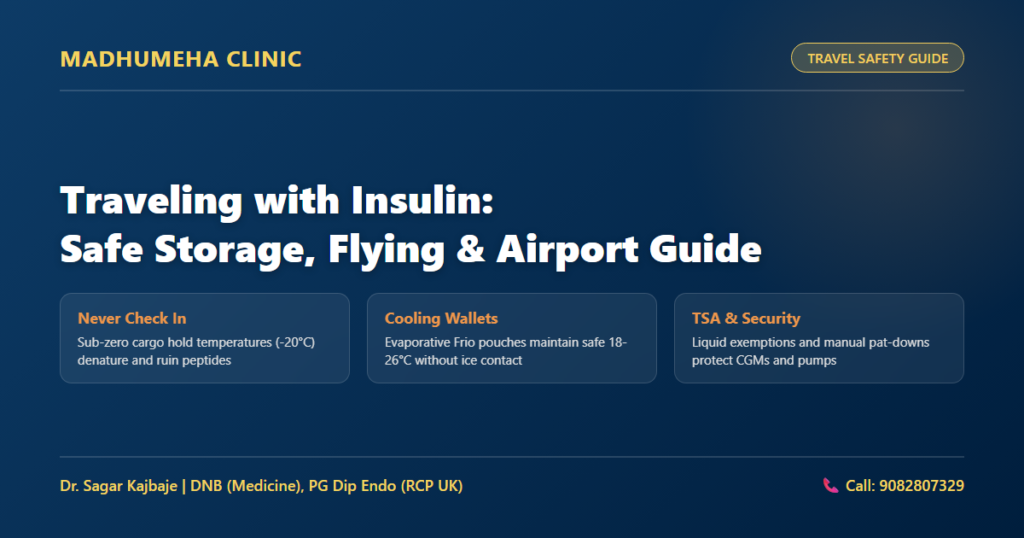
Airports bring stress. Crowds rush. Security lines crawl. Flying with diabetes demands clear familiarity with international aviation safety rules. Under official policies from the Transportation Security Administration (TSA) and Indian aviation security (CISF), medically necessary liquids carry a full exemption from standard 100 ml container limits. Security rules permit unlimited insulin carry-on. Keep your supplies inside a transparent pouch alongside original pharmacy boxes matching your travel passport. Always carry a signed doctor certificate on clinic letterhead outlining your diagnosis, specific device serial numbers, and medication schedules.
Airport Security Scanners and Diabetes Technology
Medical equipment requires careful handling at security checkpoints. Continuous glucose monitor (CGM) sensors and insulin pumps cannot tolerate whole-body millimeter-wave scanners or carry-on X-ray inspection belts. Radiation wrecks delicate circuits. Inform security officers about your wearable medical hardware before entering the scanning archway. Request a physical pat-down and hand visual inspection instead of passing through full-body imaging units. If you manage diabetes with wearable devices, our review of smart pens and insulin pumps provides useful guidance on device handling during transit.
Cabin Pressure Shifts and Bubble Expansion
Commercial aircraft cabins are pressurized to altitudes between 6,000 and 8,000 feet. This pressure drop causes dissolved air to expand into visible bubbles inside insulin cartridges and infusion lines. Air bubbles displace active fluid. If you inject without priming, you may administer air rather than insulin. Always hold your pen upright, tap the cartridge gently, and prime two units into the air before dialing your dose.
Chronotherapy Across Time Zones
Crossing multiple time zones disrupts your normal medication schedule. When flying with diabetes across three or more time zones, dose chronotherapy dictates safe basal adjustments.
Westward flights lengthen your day. Flying from Mumbai to London or New York adds several waking hours to your schedule. Because your day extends, you may require extra rapid-acting insulin with additional meals or a supplementary intermediate basal dose.
Conversely, eastward travel shortens daytime hours substantially. Crossing time zones toward Singapore or Tokyo compresses your day into a rapid cycle where standard basal doses can easily overlap, creating dangerous nocturnal hypoglycemia. Diabetologists usually recommend reducing long-acting basal insulin by 10% to 15% on eastward travel days. Read our dedicated guide on preventing silent hypoglycemia at night to stay safe while resting in hotel rooms abroad.
Building an Uncompromising Diabetic Travel Kit
A well-prepared diabetic travel kit serves as your portable clinical defense. Never pack bare minimum quantities. Travel delays happen without warning. Always pack twice as many pens, needles, and sensor units as your planned trip requires. Divide these supplies between two separate carry-on bags so a misplaced daypack does not leave you empty-handed.
Your diabetic travel kit must house primary diagnostic tools alongside rescue medications. Include a backup fingerstick glucometer with replacement CR2032 lithium batteries, sterile lancets, and sealed test strips. High altitude, dry cabin air, and coastal humidity can temporarily impair sensor accuracy, making fingerstick validation necessary.
Rapid Hypoglycemia Treatment: The 15-15 Rule
Low blood sugar requires prompt clinical action. If your blood glucose drops below 70 mg/dL during transit, apply the clinical 15-15 rule immediately:
First, consume 15 grams of fast-acting simple carbohydrates. Practical choices include three glucose tablets, half a cup of fruit juice, or three teaspoons of sugar dissolved in water. Next, rest quietly for fifteen minutes. Then, recheck your blood sugar using a fingerstick test. If your reading remains below 70 mg/dL, take another 15 grams of simple carbohydrates. Once your glucose climbs above 90 mg/dL, eat a solid snack containing complex carbohydrates and protein to prevent a secondary crash.
Evaporative Pouches Versus Cold Packs for Traveling with Insulin
Preserving insulin during outdoor journeys requires reliable thermal equipment. Many travelers pack traditional ice bricks, but rigid cold packs for traveling with insulin carry substantial risks. Direct contact with ice freezes pens rapidly. If an insulin vial rests directly against a frozen gel brick, the liquid freezes within twenty minutes. This rapid freezing shatters molecular bonds and ruins the medication. If you must use cold packs for traveling with insulin, separate your pens from the ice packs using thick insulating foam.
Evaporative Cooling Technology for Tropical Climates
Evaporative cooling pouches offer a safer approach for hot weather. These specialized fabric wallets contain polyacrylamide crystals that swell into an active gel when immersed in cool water. Moisture evaporates continuously through outer porous mesh fibers. This evaporative process draws heat away from the inner compartment, maintaining insulin safely between 18°C and 26°C for up to forty-five hours. These pouches require no electricity, making them dependable when traveling with insulin across remote areas.
Clinical Vignette: The Glove Compartment Lesson in Rajasthan
Mrs. Sunita Deshmukh (name changed) from Kalyan, a 48-year-old school administrator, discovered these physical limits during a family road trip to Rajasthan. Outdoor afternoon temperatures reached 44°C. To keep her insulin out of sight, Sunita stored her pens inside the vehicle glove compartment. She placed her pens directly against hard frozen ice packs taken from the hotel freezer.
The outcome was severe. Direct contact with the ice pack froze the cartridge liquid during the morning drive. Later that afternoon, parked vehicle heat baked the glove box to nearly 50°C, thoroughly destroying the thawed insulin peptides. Two days later, Sunita developed extreme fatigue, blurred vision, and unquenchable thirst. A fingerstick check revealed a blood glucose reading of 340 mg/dL. During a follow-up consultation, Dr. Sagar Kajbaje helped Sunita switch to water-activated evaporative cooling wallets and frequent capillary glucose checks. She promptly regained steady glycemic control.
Pre-Flight Diabetes Travel Checklist: Packing Redundancy
Thorough preparation eliminates guesswork before departure. Reviewing this diabetes travel checklist before departure prevents panic at the boarding gate:
Pack every insulin pen, syringe, and sensor unit in your carry-on luggage rather than checked bags.
Carry an official medical certificate signed by your physician listing your diagnoses and complete medication regimens.
Double your projected supply counts for pens, needles, lancets, and glucose test strips.
Keep fast-acting carbohydrates in your personal bag within easy reach throughout transit.
Pack urine or blood ketone strips to check for ketosis if unexpected illness strikes during your travels.
Schedule an appointment ahead of complex itineraries. Booking a pre-travel online diabetes consultation ensures your doctor can outline an individualized chronotherapy plan for your specific flight schedule.
Clinical Travel Matrix: Risk Mitigation by Travel Phase
To help you manage potential hazards during transit, use this clinical travel matrix:
| Travel Phase | Primary Insulin Risk | Preventive Action Plan | Required Kit Gear |
|---|---|---|---|
| Airport Security Screening | Device damage or liquid confiscation at security checkpoints | Present doctor letter and request manual hand inspection for pumps and CGMs | Transparent medical pouch with original pharmacy labels and doctor letter |
| In-Flight Cabin Transit | Micro-bubble formation and dose timing confusion across time zones | Tap cartridges upright to clear air bubbles and adjust basal timing to destination | Carry-on medical bag with spare needles, glucose meter, and fast-acting snacks |
| Road Trip / Outdoor Transit | Protein denaturing from hot vehicle interiors or direct freezing | Keep pens in evaporative cooling wallets away from glove boxes and direct sun | Water-activated evaporative cooling pouch and digital temperature card |
| Hotel Stay / Time-Zone Adjustment | Accidental freezing near hotel mini-fridge cooling coils | Test mini-fridge temperature before storing supplies or keep in-use pens at room temperature | Insulated travel flask and backup fingerstick glucometer with extra strips |
Frequently Asked Questions About Traveling with Insulin
When traveling with insulin, patients frequently raise practical questions regarding airport security, storage, and dose timing.
Can you take insulin and needles through airport security and TSA?
Yes, aviation security agencies including the TSA and India’s CISF allow insulin, syringes, and pen needles through security screening checkpoints. These medical necessities remain completely exempt from standard 100 ml liquid limitations. Place all supplies in a clear pouch with original pharmacy labels and present a signed physician letter upon request.
Can I put insulin pens or vials in checked luggage on a flight?
No, checked bags present severe freezing risks. Aircraft cargo holds routinely reach sub-zero temperatures between -20°C and -40°C during flight. Freezing permanently destroys insulin protein structures, rendering the medication biologically ineffective. Always keep all insulin in your carry-on luggage.
How do you keep insulin cold while traveling in extreme heat or outdoors?
When traveling with insulin through extreme heat, use evaporative cooling pouches or insulated containers with buffered ice packs. Never place pens in direct contact with frozen bricks, because freezing ruins peptide stability. Water-activated evaporative pouches maintain safe temperatures between 18°C and 26°C for up to forty-five hours without refrigeration.
How do you adjust insulin doses when flying across multiple time zones?
Westward flights lengthen your day, which may require supplemental rapid-acting doses or planned snacks to prevent elevated glucose levels. Eastward journeys shorten days noticeably, creating a risk of overlapping basal doses. For eastward flights across more than five time zones, doctors generally advise reducing basal insulin by 10% to 15% on travel day.
Can continuous glucose monitors (CGMs) and insulin pumps go through airport body scanners?
No, continuous glucose monitors and insulin pumps should not pass through whole-body scanners or luggage X-ray tunnels. Powerful radiation or magnetic fields can disrupt device micro-circuitry and wipe factory calibration settings. Always request a manual physical pat-down and hand visual inspection from airport security personnel.
Expert Diabetes Travel Guidance at Madhumeha Clinic
Traveling with diabetes should feel liberating rather than intimidating. With proper preparation, reliable cooling gear, and clear chronotherapy protocols, you can safely explore any destination across the globe. At Madhumeha Clinic, we help patients design practical travel strategies that protect glycemic control without disrupting vacation plans.
Consultant: Dr. Sagar Kajbaje, DNB (General Medicine), Post Graduate Diploma in Diabetes and Endocrinology, Royal College of Physicians (UK), 15+ years experience.
Consultation Fee: Rs. 300 (First consultation & follow-up).
Personalized Travel Planning: Call: 9082807329.
Planning an upcoming flight? Read our comprehensive protocol on how to travel with diabetes to prevent peptide freeze denaturation in cargo holds and navigate security checkpoints safely.
Senior citizens facing recurrent nocturnal dips should also review our specialized clinical recommendations on elderly diabetes care and sarcopenia management.
Patients with longstanding diabetes experiencing peripheral numbness or nocturnal symptoms should also review our clinical recommendations on diabetic foot care and ulcer prevention. While on the road, maintaining consistency in your proper insulin injection locations and technique ensures steady absorption and avoids sudden blood sugar volatility.
[…] you take daily injections or wear an insulin pump on the go, read our complete guide on traveling with insulin covering airport TSA rules, cooling pouches, and in-flight […]